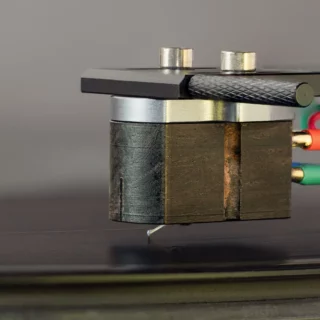

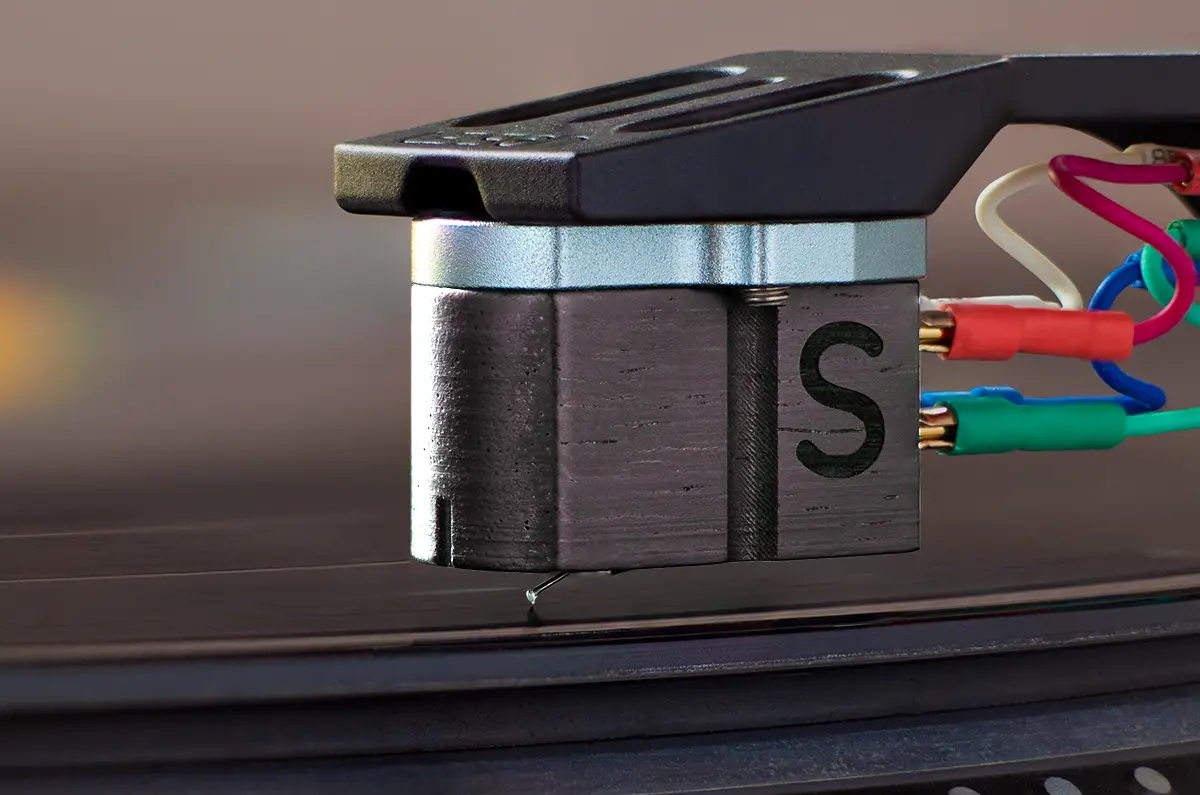
LS10 MKII “S” Cartridge
The LS10 wound in 5N OCC silver, with a 0.5 mV output that suits most MC phono stages
1,490 $
Shipping and customs duties included
Worldwide delivery, duties and taxes included. Main markets: typically 8–16 days. See times by region
Atelier direct price i
Atelier direct price
The LS10 wound in 5N OCC silver, with a 0.5 mV output that suits most MC phono stages
Customer reviews on Trustpilot
Customer reviews on Trustpilot
The LS10 wound in 5N OCC silver, with a 0.5 mV output that suits most MC phono stages
A low-output design with coils of 5N OCC silver, the most conductive metal there is
Every LS10 shares the same platform. The “S” is the version wound in silver: coils of 5N OCC silver, the most conductive metal there is, so the signal the stylus lifts from the groove meets less resistance on its way to your phono stage.
The “S” keeps a practical 0.5 mV of output, so it asks only what a capable MC phono stage already provides: 56 to 65 dB of gain and a load of 75 ohms or more.
If you are not sure the cartridge matches your tonearm and phono stage, send us your system details and I will check the match before you order.
Gregory, founder

How the LS10 MKII “S” fits within the Le Son range
If your phono stage has a moving-magnet input only, the SL1 MKII is the version built for it.
 LS10 MKII LS10 MKII |
 LS10 MKII “S” LS10 MKII “S” |
 LS10 MKII “G” LS10 MKII “G” |
 SL1 MKII SL1 MKII |
|
|---|---|---|---|---|
| Price | 990 $ | 1,490 $ | 1,890 $ | 690 $ |
| Place within the collection | Core low-output MC | Silver-coil low-output MC | Very low-output flagship | High-output MC for MM inputs |
| Output | 0.40 mV | 0.50 mV | 0.10 mV | 2.5 mV |
| Phono stage context | MC phono stage | MC phono stage | High-gain MC stage or quality SUT | MM phono stage |
| Suggested overall gain | 56 to 65 dB | 56 to 65 dB | 70 to 78 dB | Standard MM input |
| Coil material | 6N OFC Copper | 5N OCC Silver | Gold-plated 5N OCC Copper | 6N OFC Copper |
| Cantilever | Boron Nitride Rod | Boron Rod | Boron Nitride Rod | Boron Nitride Rod |
| Stylus | Shibata V | Line Contact | Special Line Contact | Line Contact |
| Compliance | 15 μm/mN | 15 μm/mN | 15 μm/mN | 16 μm/mN |
| Tonearm effective mass | 5–25 g | 5–25 g | 5–25 g | 4–24 g |
| Sonic character | Balanced, vivid, captivating | Refined, fluent, involving | Effortless, full-bodied, mesmerizing | Clear, warm, enveloping |
| Choose it if | your system has suitable MC gain and you want the core low-output Le Son reference | you want greater openness and nuance while staying within a straightforward gain structure | your system is ready for a 0.10 mV cartridge and you want the most advanced LS10 expression | your phono stage uses an MM input and you want a high-output moving-coil cartridge |
| View LS10 MKII | View LS10 MKII “G” | View SL1 MKII |
Not sure which one suits your system? Contact the atelier, and we will review the match before you order.
Wound in silver
Of all metals, silver is the most conductive. This is not a claim but a property: no other conductor offers the signal lower natural resistance. The “S” is the LS10 wound in this metal, at a grade we state in full: 5N OCC silver, 99.999 percent pure, drawn as a single continuous crystal into a wire 0.03 mm across.
This wire is the first path the music ever takes as an electrical signal. The stylus traces the groove, the cantilever carries the motion, and in the coils that motion becomes the signal every later stage can only amplify. Whatever happens in those first turns of wire is in the music for good.
This is why the drawing process matters as much as the metal itself. Ordinary wire is made of many small crystals, with each boundary adding a minute discontinuity. OCC silver is different. Drawn as one continuous crystal, it gives the most delicate signal an unbroken path from the first movement of the coil.
The grade is stated because it expresses the purpose of the “S”: the first wire the music travels through should disturb as little as possible of what the stylus found in the groove.
The kinetic precision of boron
The stylus never speaks to the coils directly. Everything it reads travels along the cantilever as vibration, and whatever bends, stores or blurs on the way is gone before the music ever becomes a signal.
So the “S” uses a boron rod. For its weight, boron is among the stiffest materials a cantilever can be made from, far stiffer than the aluminum found in most cartridges, and this is what stiffness buys: the groove’s motion arrives at the coils quickly and completely, without an echo of the messenger itself.
Stiffness-to-weight ratio (GPa/g/cm3)
The design intent is simple. The smallest movements in the groove, the ones that carry texture and touch, should reach the coils intact, in a cartridge whose first wire is already chosen to lose nothing of them.
Refined line-contact geometry
There is more than one way to cut a diamond for a record groove. The “S” carries a nude line-contact stylus whose profile sits between the well-known Shibata and Fritz Gyger shapes: a long, narrow contact patch that reads finer modulations than a rounded tip can reach, with more setup tolerance than the most extreme line-contact designs.
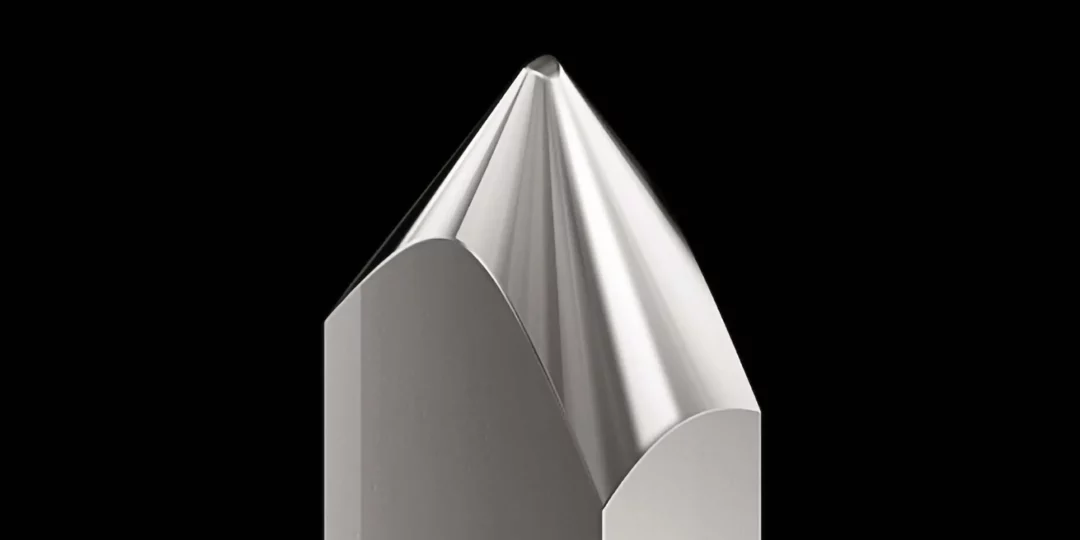
The longer contact patch also spreads the tracking force over more surface, which is gentler on the groove and on the diamond itself. Precision here does not mean fragility: this profile was chosen to be lived with, aligned carefully once, then simply played.
A profile this refined still rewards unhurried alignment. It is why personal setup guidance accompanies every “S”.
Easy installation
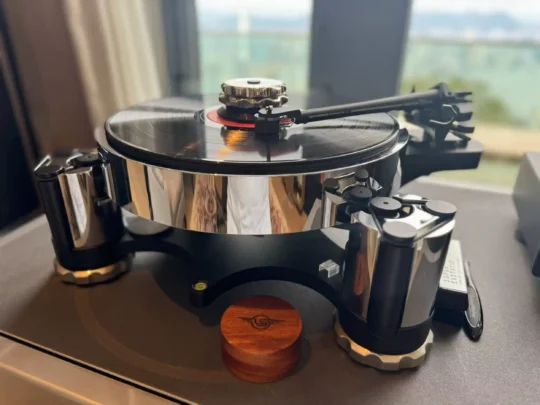
The LS10 MKII “S” uses a pre-threaded body, so mounting does not require loose nuts.
Its straight sides also make visual alignment easier, helping the installation feel calmer and more controlled.
And if any step raises a question, send a photo of your setup and we will look at it with you.
Personal setup guidance
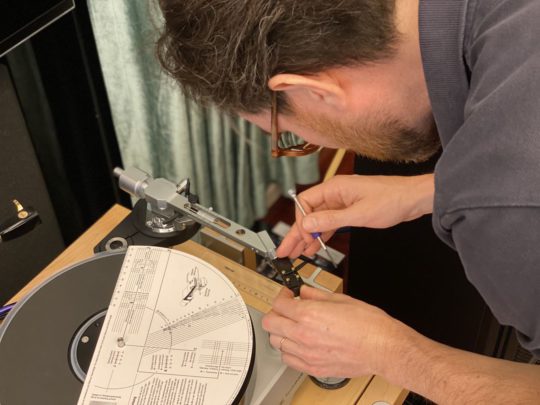
With every LS10 MKII “S” cartridge, we are happy to help you review the key setup points before listening seriously.
This may include mounting, alignment, tracking force, anti-skate, phono-stage gain and loading.
The guidance does not end at delivery. As the “S” settles in, send us your impressions or questions and we will help you fine-tune gain, loading and geometry until it sits exactly right in your system.
This direct guidance is part of the Le Son experience.
60-day home evaluation
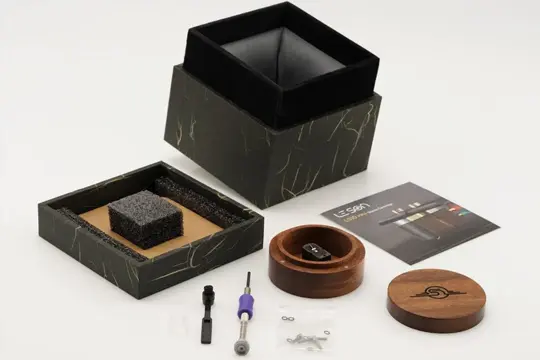
The LS10 MKII “S” can be evaluated where it matters most: in your own system, with your own tonearm, phono stage and records.
You have 60 days to listen calmly, allow the cartridge to settle, refine the setup and decide whether it belongs in your analog front end.
If it is not the right match, please contact us within the evaluation period and we will guide you through the return process according to our return conditions.
Specifications
Physical
- Cartridge Type: Moving Coil (Stereo)
- Coils: 5N OCC Silver
- Cantilever: Boron Rod
- Stylus: Nude Diamond, Line Contact Shape
- Body: Aluminum & Carbon Fiber Socket, Ebony Wood Casing
- Weight: 8.2 grams
Electrical
- Output Voltage: 0.50 mV at 5 cm/s
- Internal Impedance: 6 ohms
- Frequency Response: 15 – 45,000 Hz
- Channel Separation: Better than 30 dB at 1 kHz
- Channel Balance: Better than 0.5 dB
Dynamic
- Tracking ability: 80 μm at 315 Hz with 2 g tracking force
- Dynamic Compliance: 15 μm/mN at 10 Hz
Setup
- Recommended Loading: 75 ohms minimum
- Recommended Gain: approximately 56–65 dB, or a suitable step-up transformer
- Recommended Vertical Tracking Force (VTF): 1.9 – 2.5 grams
- Reference Vertical Tracking Force (VTF): 2.2 grams
- Recommended Tonearm Mass: Medium
- Run-in Period: 30 hours
Accessories
- 1 x Stylus Brush
- 1 x Vessel Hexagonal Screwdriver
- 1 x Stylus Guard
- 2 x Short Titanium Mounting Screws
- 2 x Medium Titanium Mounting Screws
- 2 x Long Titanium Mounting Screws
- 6 x Graphite / Nylon Washers
60-day home evaluation · Direct atelier guidance on matching and loading · 2-year warranty
Frequently Asked Questions
- Is there a warranty for the LS10 MKII “S” cartridge?
- Which tonearms are compatible with the LS10 MKII “S”?
- What is the expected stylus lifespan?
- Can the LS10 MKII “S” be retipped or rebuilt?
- What phono preamp gain is recommended?
- How does the LS10 MKII “S” compare with the LS10 MKII and LS10 MKII “G”?
- Is the LS10 MKII “S” returnable if it does not match my system?
- Do you offer setup assistance?
- What information should I send before ordering?
Yes. The LS10 MKII “S” is covered by a 2-year warranty under normal use.
Warranty coverage applies to defects in materials or workmanship. It does not cover misuse, improper installation, unauthorized modification, external damage, or normal stylus wear.
If an issue appears, please contact us with your order details, serial number and a clear description of the symptom.
The LS10 MKII “S” has a dynamic compliance of 15 μm/mN and is generally intended for medium-mass tonearms.
The ideal match still depends on the full setup, including tonearm effective mass, headshell, mounting hardware and phono-stage configuration.
If you are unsure, send us your turntable, tonearm and phono-stage details before ordering. We will be happy to help you check whether the LS10 MKII “S” is a coherent match.
Stylus life depends on setup accuracy, record cleanliness, tracking force, handling and hours of use.
With clean records and correct tracking force, the line-contact stylus typically serves 800 to 1,000 hours of listening before renewal. From around 800 hours, we recommend a stylus inspection: we examine the cartridge under the microscope and advise before any work is quoted.
If tracking, distortion or tonal balance changes noticeably after extended use, contact us at any time.
Yes. The LS10 MKII “S” can be retipped in our atelier, from $450.
When the stylus is worn, or if performance changes after long use, please contact us and we will confirm the most suitable service path.
Current conditions, pricing and timing are confirmed before any work begins.
The LS10 MKII “S” has an output of 0.50 mV at 5 cm/s and is intended for a suitable MC phono stage or an MM phono stage used with an appropriate step-up transformer.
As a practical starting point, many systems will be comfortable with MC gain in the approximate 56 to 65 dB region.
Recommended loading starts at 75 ohms minimum. If your phono stage allows adjustment, a balanced working range is often around 80 to 120 ohms.
The LS10 MKII is the core low-output Le Son reference and the most balanced starting point in the LS10 family.
The LS10 MKII “S” is the version wound in 5N OCC silver: the same design discipline as the flagship “G”, at an output most serious MC phono stages are ready for.
The LS10 MKII “G” is the apex of the line, taken to its lowest output and lightest moving system. It is the natural choice once the gain, loading and noise floor of the system are ready for a 0.10 mV cartridge.
Eligible cartridge returns fall within our 60-day home evaluation framework, provided return conditions are met.
The cartridge should be returned in appropriate condition and will be inspected after receipt.
If you are unsure before ordering, please contact us with your system details so we can help you choose carefully.
Yes. We are happy to help you review the key setup points for the LS10 MKII “S,” including tracking force, alignment, anti-skate, VTA/SRA starting point, gain and loading.
The more complete your system information, the better we can guide you.
Useful details include turntable, tonearm, phono stage, gain and loading options, current cartridge and listening priorities.
Please send your turntable model, tonearm model, phono stage model, available gain and loading settings, current cartridge and listening priorities.
This allows us to check the mechanical and electrical match before you order.
For the LS10 MKII “S”, this also confirms the gain and loading match, so the cartridge arrives into a system that is ready for it.
Not sure whether the LS10 MKII “S” suits your system?
Our Before You Buy guide covers the main compatibility questions, including tonearm mass, phono-stage gain and loading.
If you would like personal advice, send us your turntable, tonearm and phono-stage details. We will be happy to help you choose with confidence.